

In the Seinfeld episode “The Opposite,” George Costanza concludes that nearly every instinct he follows leads him astray. Jerry offers a deceptively simple solution: “If every instinct you have is wrong, then the opposite would have to be right.”
George puts the theory to the test. Instead of trying to impress a woman at Monk’s café, he introduces himself by announcing that he is unemployed and lives with his parents. Somehow, the approach works. Soon he has a girlfriend, a job with the Yankees, and a very different life.
Retirement investing may have its own version of “The Opposite.” What if, instead of concentrating almost exclusively on finding investments that will rise more than the market, fiduciaries looked for investments designed to lose less when markets fall?
The problem with chasing the next winner
Much of traditional active management seeks to outperform by selecting securities, sectors, or factors expected to do better than a benchmark. If those selections succeed, the portfolio benefits. But identifying the next winning manager or strategy in advance is difficult. A strong recent record may reflect a favorable market environment that does not persist, rather than repeatable manager skill.
For investment fiduciaries, this presents a practical problem: trailing returns are observable, but the conditions that produced them may not repeat. A manager that excelled in a rising market may offer little protection when that market reverses.
There is another way to examine the potential for long-term outperformance. It starts not with a forecast of what will rise most, but with the arithmetic of what happens after capital is lost.
The asymmetry of loss and recovery
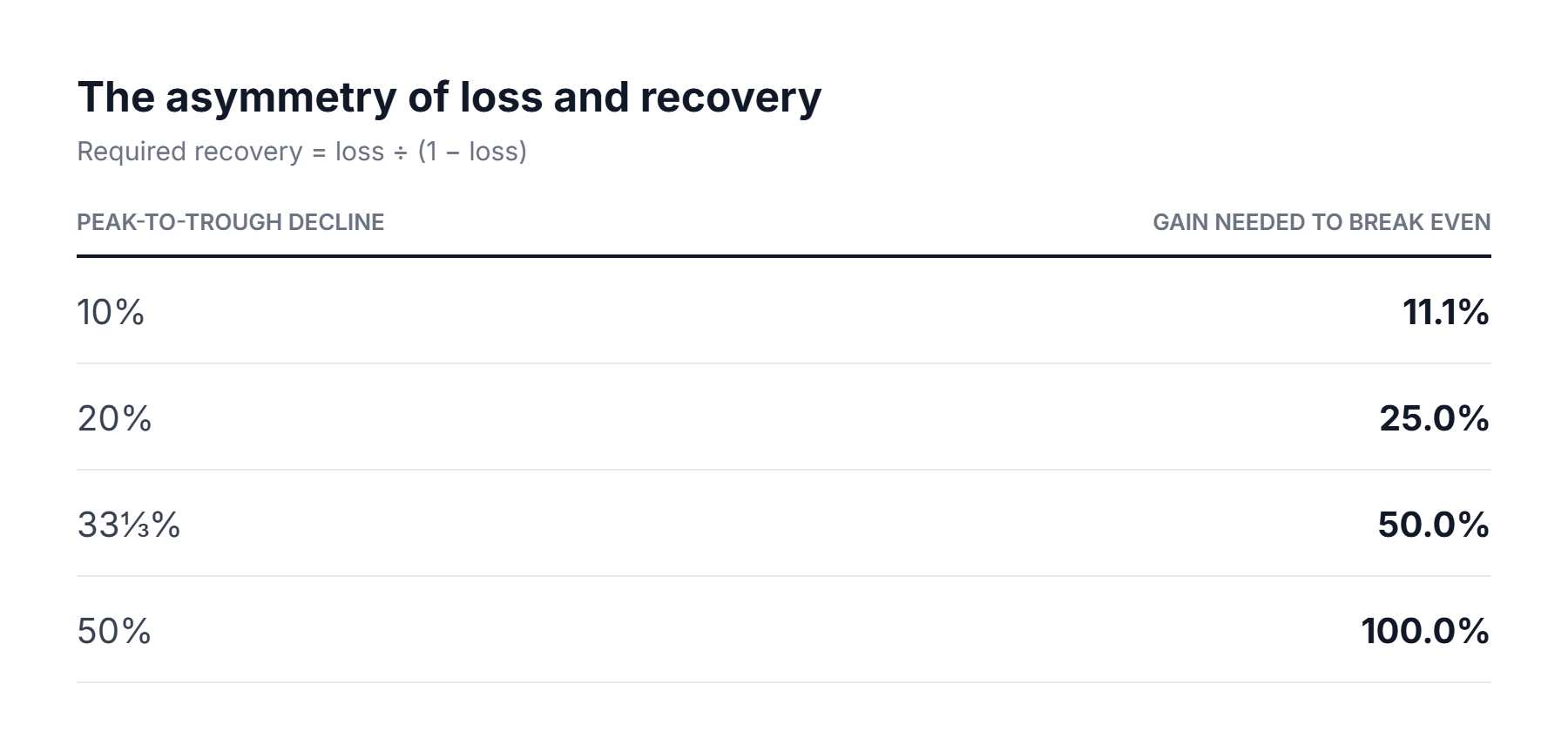
A loss and an equal-sized gain do not cancel each other out. A portfolio that falls 20% needs a 25% gain to recover. A portfolio that falls by one-third needs a 50% gain. After a 50% loss, the required gain is 100%.
The formula is straightforward: required recovery = loss ÷ (1 − loss), with the loss expressed as a decimal. As the loss deepens, the required recovery rises at an accelerating rate.
Now consider two hypothetical portfolios, each starting with $100. The benchmark falls by one-third and then rebounds 50%, ending back at $100. A second portfolio declines 20% and then gains 40%. Although it participates less in the rebound, it finishes at $112.
The second portfolio wins the full sequence without winning the recovery period. It had more capital left to compound. In this illustration, reducing the initial decline by 13⅓ percentage points cuts the gain needed to break even from 50% to 25%. That is the mathematical asymmetry of loss and recovery.
Net Capture: measuring both sides of the market
Most fund evaluations begin with return rankings. An equally important question is how those returns were produced. How much of the benchmark’s gains did the portfolio capture? How much of its losses?
Upside Capture measures participation when the benchmark rises. Downside Capture measures participation when it falls. Net Capture is the difference between the two: Upside Capture minus Downside Capture. A strategy with higher upside participation than downside participation has positive Net Capture, as measured over the specified period.
In the simplified example above, the second portfolio captures 80% of the benchmark’s rebound and 60% of its decline. Its illustrative Net Capture is therefore +20 percentage points. That relationship helps explain why a strategy can trail during a rally yet finish ahead across a full decline-and-recovery cycle. This illustrates how a portfolio can lose less in a bear market and still underperform over time even if it gives up substantial upside or pays too much for protection.
Why this matters for 401(k) participants
For younger participants, the benefit of shallower losses is the possibility of keeping more capital invested for decades of subsequent compounding. For participants approaching or entering retirement, the issue becomes more urgent. A sharp decline early in retirement, combined with ongoing withdrawals, can reduce the assets available to benefit from a later recovery. This sequence-of-returns risk can damage the sustainability of retirement income even when long-run average returns appear satisfactory.
There may also be a behavioral benefit. Severe drawdowns can prompt participants to abandon a long-term allocation at precisely the wrong time. A portfolio that experiences smaller declines may be easier to hold through market stress, although no investment structure can ensure disciplined participant behavior.
The fiduciary objective is not to minimize loss at any price. It is to select investments that offer an appropriate balance of growth potential, downside exposure, costs, and suitability for the participants who will rely on them.
A different question for fiduciaries
The familiar question is, “Which manager is most likely to beat the market?” A more revealing question may be, “Which portfolio offers the most favorable relationship between the upside it captures and the downside it absorbs?”
That change in perspective does not eliminate the need for manager due diligence. It makes the due diligence more complete. Advisors should evaluate downside and upside capture together, examine the sources of each, test sensitivity to different market environments, and consider whether any historical advantage survives costs.
The goal is not simply to own investments that rise less or fall less. It is to compound more effectively over the full market cycle.
George Costanza improved his fortunes by questioning an instinct he had never thought to challenge. Investment fiduciaries may benefit from doing the same. Instead of always asking how to capture more of the next advance, start by asking how to keep more of what investors already have.
Sometimes, the opposite works.
Illustrations are hypothetical and do not represent actual fund performance. Returns and capture measures in the example exclude the implementation challenges and costs of achieving the assumed outcomes. All investing involves risk, including loss of principal. Downside management does not eliminate losses or assure outperformance.


